Uses of the greatly superior method of conservation tillage (no-till) include:
•
farmland production of crops for food, feed, fiber, and fertilizer;
•
significant reversal of
global warming
if extensively applied;
•
the revegetation of degraded grasslands, savannas, shrublands and forests;
•
originally,
the
non-arable
land
production
of
biofuel
feedstock
such
as
switchgrass
and
giant
reed
grass;
however,
at
present
there
is
an
international
concern
about
using
crops
for
fuel
production due to the present critical food shortages .
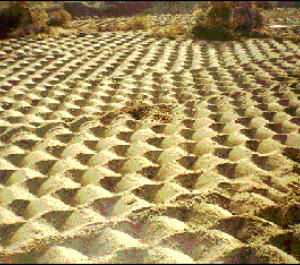

Land
imprints
wedged
into
the
soil
surface
by
rolling
8-pointed
steel
stars
in
the
Mojave
Desert
near
Pearblossom , CA
.
The
W
all
Street
Journal
Innovation
Award
(see
link
below)
has
greatly
helped
the
Imprinting
Foundation
advance
its
current
mission
of
technology
transfer
from
California
to
Saudi
Arabia.
Other milestones include publication of (see *References below) :
•
Detailed
scientific
(hydrologic)
basis
for
land
imprinting
in
an
important
soil
and
water
conservation journal ( Dixon 1995).
•
Data
detailing
how
land
imprinting
is
a
superior
method
for
establishing
vegetation
relative
to
the conventional rangeland drill ( Dixon 1990).
•
A
paper
detailing
the
results
of
two
large
(500
&
250
acres)
ecological
restoration
projects
near
Tucson , Arizona (Dixon and Carr 1999).
•
Independent
research
studies
conducted
in
southern
California
showing
imprinting
to
be
a
superior
method
for
controlling
soil
erosion
and
seeding
native
vegetation
as
compared
to
conventional methods ( Forest etal. 2002 and Montalvo etal. 2002).
•
Three
books
which
indicate
the
superiority
of
land
imprinting
relative
to
conventional
methods
of
seeding (Bainbridge 2007, Lancaster 2008, Galatowitsch 2008).
•
Land
imprinting
machine
specifications
that
are
detailed
enough
to
promote
the
building
of
home-made imprinters.(Dixon and Carr 2004).

The Imprinting Foundation: Who Are We?
The
Imprinting
Foundation's
focus
is
to
present
breakthrough
technology
for
ecological
restoration/conservation
to
those
directly
involved
in
the
agricultural
sector,
as
well
as
those
who
are
in
the
position
of
decision-making
in
agricultural
and
food
concerns.
The
Imprinting
Foundation
was
founded
in
1986,
by
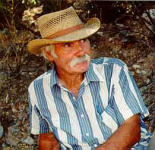
Dr.
Robert
Dixon
(click
on
his
picture
below
to
see
his
impressive
background
in
this field).
*REFERENCES
Bainbridge, D.A. 2007. A Guide for Desert and Dryland Restoration. New Hope for Arid Lands. Island Press, Washington, DC.
Dixon
,
RM.
1990.
Land
imprinting
for
dryland
revegetation
and
restoration.
In:
Environmental
Restoration:
Sciences
and
Strategy
for
Restoring
the
Earth.
Edited, John J. Berger. Island Press. Washington , D.C. p. 14-22.
Dixon , R.M. 1995. Water infiltration control at the soil surface: theory and practice. J. Soil & Water Cons. 50(5): 450-453.
Dixon
,
R.M.
and
A.B.
Carr
1999.
Land
imprinting
for
restoring
vegetation
in
the
Desert
Southwest
Proc.
25th
Conference
on
Ecosystems
Restoration
and
Creation. Hillsborough Community College and Institute of Florida Studies. P. 103-109.
Dixon
,
R.M.
and
A.B.
Carr
2004.
Land
imprinting
standards
for
accelerating
succession
past
the
exotic
weed
stage.
Sixteenth
International
Conference,
Society for Ecological Restoration, August 24-25, Victoria , Canada , pdf available.
Forest
,
C.L.,
M.V.
Harding,
N.
Gardiner,
H.H.
Chang
2002.
CALTRANS
erosion
control
pilot
study.
Proc.
Conference
33,
International
Erosion
Control
Association. P. 335-343.
Galatowitsch, S. 2008. Seeding establishment in restored ecosystems. In: Seeding Ecology and Evolution. Cambridge University Press.
Lancaster , B. 2008. Rainwater Harvesting for Drylands and Beyond. Volume 2, Water Harvesting Earthworks. Resource Press, Tucson , Arizona.
Montalvo,
A.M.,
P.A.
McMillan
and
E.B.
Allen,
2002.
The
relative
importance
of
seeding
method,
soil
ripping,
and
soil
variables
on
seeding
success.
Restoration Ecology 10:52-67.
Wall Street Journal 2007. Technology 2007 Awards for Innovation, Technology Innovation Winners, Imprinting Foundation, Monday, September 22, R4.
Click on our logo for interview regarding the 2007 Wall Street Journal Award!

A Non-Profit Organization
The Imprinting Foundation
1616 E. Lind Road
Tucson, Arizona 85719
Please visit our Contact Us page for ways on how you can assist us in restoring the planet and
helping humanity.



Dr. Robert Dixon






To email us, click on logo to left









Uses of the greatly superior method of conservation tillage (no-till) include:
•
farmland production of crops for food, feed, fiber, and fertilizer;
•
significant reversal of
global warming
if extensively applied;
•
the revegetation of degraded grasslands, savannas, shrublands and forests;
•
originally,
the
non-arable
land
production
of
biofuel
feedstock
such
as
switchgrass
and
giant
reed
grass;
however,
at
present
there
is
an
international
concern
about
using
crops
for
fuel
production
due
to
the
present critical food shortages .

The
W
all
Street
Journal
Innovation
Award
(see
link
below)
has
greatly
helped
the
Imprinting
Foundation
advance
its
current
mission
of
technology
transfer
from
California
to
Saudi
Arabia.
Other
milestones
include
publication
of
(see
*References
below) :
•
Detailed
scientific
(hydrologic)
basis
for
land
imprinting
in
an
important
soil
and
water conservation journal ( Dixon 1995).
•
Data
detailing
how
land
imprinting
is
a
superior
method
for
establishing
vegetation relative to the conventional rangeland drill ( Dixon 1990).
•
A
paper
detailing
the
results
of
two
large
(500
&
250
acres)
ecological
restoration projects near Tucson , Arizona (Dixon and Carr 1999).
•
Independent
research
studies
conducted
in
southern
California
showing
imprinting
to
be
a
superior
method
for
controlling
soil
erosion
and
seeding
native
vegetation
as
compared
to
conventional
methods
(
Forest
etal.
2002
and
Montalvo etal. 2002).
•
Three
books
which
indicate
the
superiority
of
land
imprinting
relative
to
conventional
methods
of
seeding
(Bainbridge
2007,
Lancaster
2008,
Galatowitsch 2008).
•
Land
imprinting
machine
specifications
that
are
detailed
enough
to
promote
the building of home-made imprinters.(Dixon and Carr 2004).
The Imprinting Foundation: Who Are We?
The
Imprinting
Foundation's
focus
is
to
present
breakthrough
technology
for
ecological
restoration/conservation
to
those
directly
involved
in
the
agricultural
sector,
as
well
as
those
who
are
in
the
position
of
decision-making
in
agricultural
and
food
concerns.
The
Imprinting
Foundation
was
founded
in
1986,
by
Dr.
Robert
Dixon (click on his picture below to see his impressive background in this field).
*REFERENCES
Bainbridge,
D.A.
2007.
A
Guide
for
Desert
and
Dryland
Restoration.
New
Hope
for
Arid
Lands. Island Press, Washington, DC.
Dixon
,
RM.
1990.
Land
imprinting
for
dryland
revegetation
and
restoration.
In:
Environmental
Restoration:
Sciences
and
Strategy
for
Restoring
the
Earth.
Edited,
John
J.
Berger.
Island
Press. Washington , D.C. p. 14-22.
Dixon
,
R.M.
1995.
Water
infiltration
control
at
the
soil
surface:
theory
and
practice.
J.
Soil
&
Water Cons. 50(5): 450-453.
Dixon
,
R.M.
and
A.B.
Carr
1999.
Land
imprinting
for
restoring
vegetation
in
the
Desert
Southwest
Proc.
25th
Conference
on
Ecosystems
Restoration
and
Creation.
Hillsborough
Community College and Institute of Florida Studies. P. 103-109.
Dixon
,
R.M.
and
A.B.
Carr
2004.
Land
imprinting
standards
for
accelerating
succession
past
the
exotic
weed
stage.
Sixteenth
International
Conference,
Society
for
Ecological
Restoration, August 24-25, Victoria , Canada , pdf available.
Forest
,
C.L.,
M.V.
Harding,
N.
Gardiner,
H.H.
Chang
2002.
CALTRANS
erosion
control
pilot
study. Proc. Conference 33, International Erosion Control Association. P. 335-343.
Galatowitsch,
S.
2008.
Seeding
establishment
in
restored
ecosystems.
In:
Seeding
Ecology
and Evolution. Cambridge University Press.
Lancaster
,
B.
2008.
Rainwater
Harvesting
for
Drylands
and
Beyond.
Volume
2,
Water
Harvesting Earthworks. Resource Press, Tucson , Arizona.
Montalvo,
A.M.,
P.A.
McMillan
and
E.B.
Allen,
2002.
The
relative
importance
of
seeding
method, soil ripping, and soil variables on seeding success. Restoration Ecology 10:52-67.
Wall
Street
Journal
2007.
Technology
2007
Awards
for
Innovation,
Technology
Innovation
Winners, Imprinting Foundation, Monday, September 22, R4.
Click on our logo for interview regarding the 2007 Wall Street Journal Award!













Email Web Mistress

To email us, click on
logo to left
