THE IMPRINTING FOUNDATION:
Its Origins
Dedicated to the development and extension of new technologies promoting sustainable agriculture and ecological restoration
This
is
a
brief
history
of
the
no-tillage
method
of
planting
&
seeding
called
land
imprinting.
This
method,
invented
in
1976,
is
the
first
uniquely
new
approach
for
large scale seeding and planting developed in the past 3 centuries after Jethro Tull invented the seed drill in 1702.
Unlike
the
Tull
drill
and
similar
developments
during
the
past
several
centuries,
the
imprinter
does
not
make
continuous
furrows
that
tend
to
bleed
land
resources
downslope
when
water
arrives
at
the
air-earth
interface
(AEI)
in
the
form
of
rainfall,
snow
melt
and
irrigation.
These
continuous
furrows,
and
often
the
need
for
pre-drill
tillage,
make
the
Tull-type
drill
an
unsustainable
cultural
practice
due
to
accelerated
water
runoff
and
soil
erosion,
especially on sloping land.
Tombstone
Prototype
In
contrast,
Imprinters
make
staggered
V-shaped
pockets,
one-square-foot
in
size,
that
funnel
resources
together
in
the
bottom
of
the
Vee
where
they
can
work
in
concert
to
germinate
seeds
and
establish
seedlings
using
a
minimal
amount
of
water.
Imprints
are
formed
by
vertical
and
lateral
forces
acting
on
V-shaped
steel
teeth
welded
to
the
surface of a steel roller in a staggered pattern. The teeth wedge their way into the soil surface.
Imprinters
are
based
on
AEI
research
that
found
that
the
two
main
properties
controlling
water
infiltration
into
dry
soils
were
AEI
micro
roughness
and
macro-porosity.
Land
imprinting
was
developed
to
control
these
two
properties
at
high
levels
with
minimal
soil
disturbance.
Finally,
land
imprinting
excels
at
holding
soil
and
water
resources
in
place
for
seed
germination,
seedling
establishment
and
plant
growth.
Land
imprinting
specifications
have
been
recently
established
for
achieving
sustainable
agriculture
and
ecological
restoration
of
degraded
land. These specifications will be updated periodically because land imprinting is a work in progress indefinitely into the future.
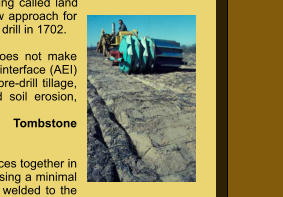











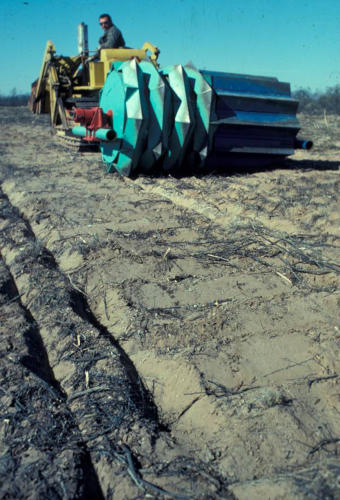
click on photo to enlarge






To email us, click on logo to left



THE IMPRINTING FOUNDATION:
Its Origins
Dedicated to the development and extension of new
technologies promoting sustainable agriculture and
ecological restoration
This
is
a
brief
history
of
the
no-tillage
method
of
planting
&
seeding
called
land
imprinting.
This
method,
invented
in
1976,
is
the
first
uniquely
new
approach
for
large
scale
seeding
and
planting
developed
in
the
past
3
centuries
after
Jethro
Tull
invented
the seed drill in 1702.
Unlike
the
Tull
drill
and
similar
developments
during
the
past
several
centuries,
the
imprinter
does
not
make
continuous
furrows
that
tend
to
bleed
land
resources
downslope
when
water
arrives
at
the
air-earth
interface
(AEI)
in
the
form
of
rainfall,
snow
melt
and
irrigation.
These
continuous
furrows,
and
often
the
need
for
pre-drill
tillage,
make
the
Tull-type
drill
an
unsustainable
cultural
practice
due
to
accelerated
water runoff and soil erosion, especially on sloping land.
Tombstone Prototype
In
contrast,
Imprinters
make
staggered
V-shaped
pockets,
one-
square-foot
in
size,
that
funnel
resources
together
in
the
bottom
of
the
Vee
where
they
can
work
in
concert
to
germinate
seeds
and
establish
seedlings
using
a
minimal
amount
of
water.
Imprints
are
formed
by
vertical
and
lateral
forces
acting
on
V-
shaped
steel
teeth
welded
to
the
surface
of
a
steel
roller
in
a
staggered
pattern.
The
teeth
wedge
their
way
into
the
soil
surface.
Imprinters
are
based
on
AEI
research
that
found
that
the
two
main
properties
controlling
water
infiltration
into
dry
soils
were
AEI
micro
roughness
and
macro-porosity.
Land
imprinting
was
developed
to
control
these
two
properties
at
high
levels
with
minimal
soil
disturbance.
Finally,
land
imprinting
excels
at
holding
soil
and
water
resources
in
place
for
seed
germination,
seedling
establishment
and
plant
growth.
Land
imprinting
specifications
have
been
recently
established
for
achieving
sustainable
agriculture
and
ecological
restoration
of
degraded
land.
These
specifications
will
be
updated
periodically
because
land
imprinting
is
a
work
in
progress indefinitely into the future.
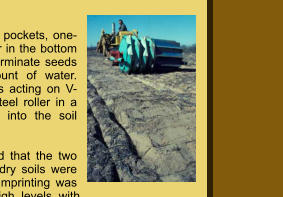










click on photo to enlarge


Email Web Mistress

To email us, click on
logo to left